
We were in Connersville today for a home inspection, and the attic told the story before the living space did. Dark staining on the attic sheathing and on the wood ceiling below is the kind of finding that raises a simple question — is this just water damage, or is there possible mold with it? Every photo in this post is from today’s job.
What we saw in the attic and on the ceiling
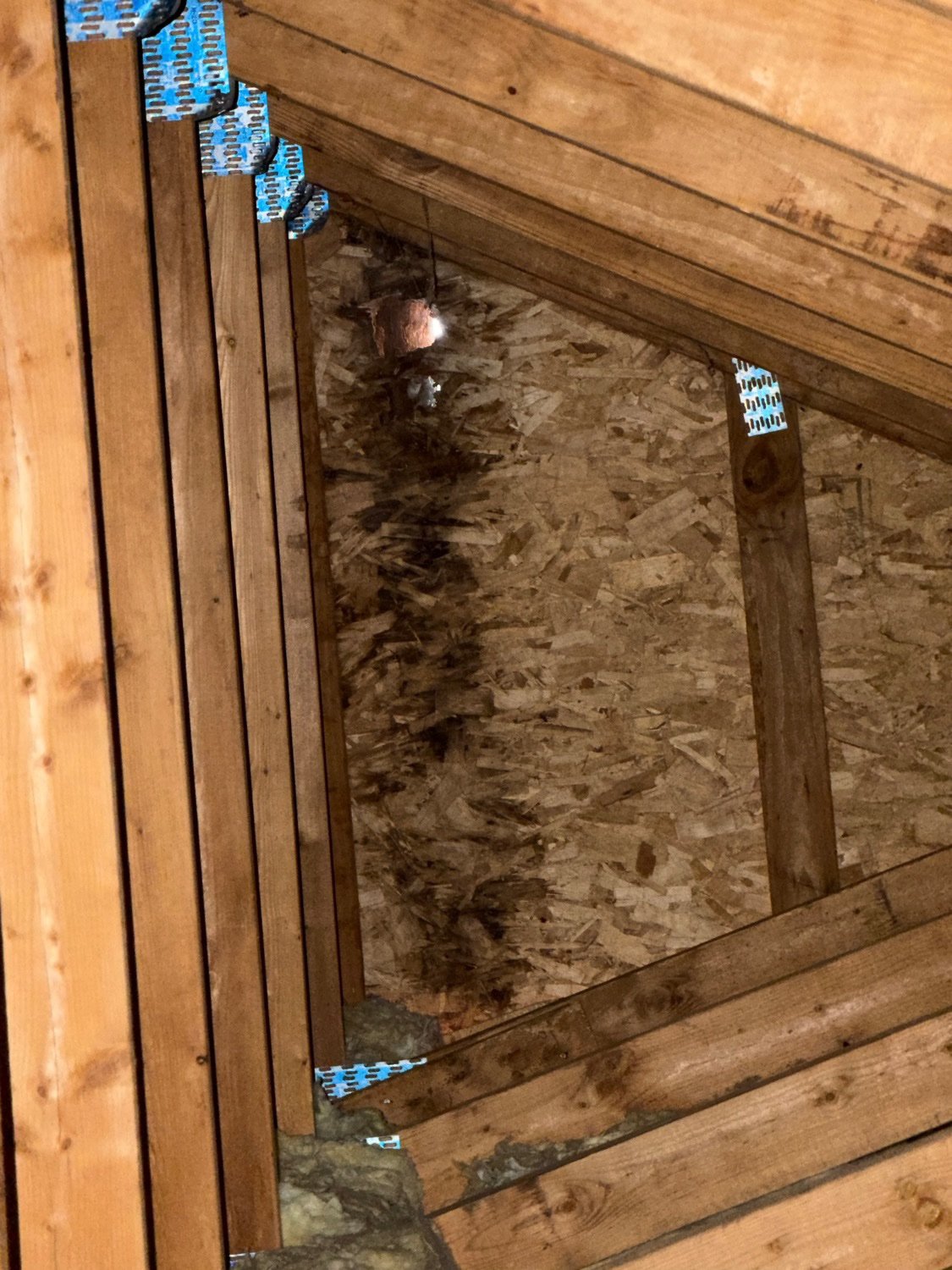
In the attic, the gable-end OSB sheathing shows dark water staining running down from near a vent penetration. Below, the tongue-and-groove wood ceiling shows dark, mottled moisture staining, including above the stone chimney wall.
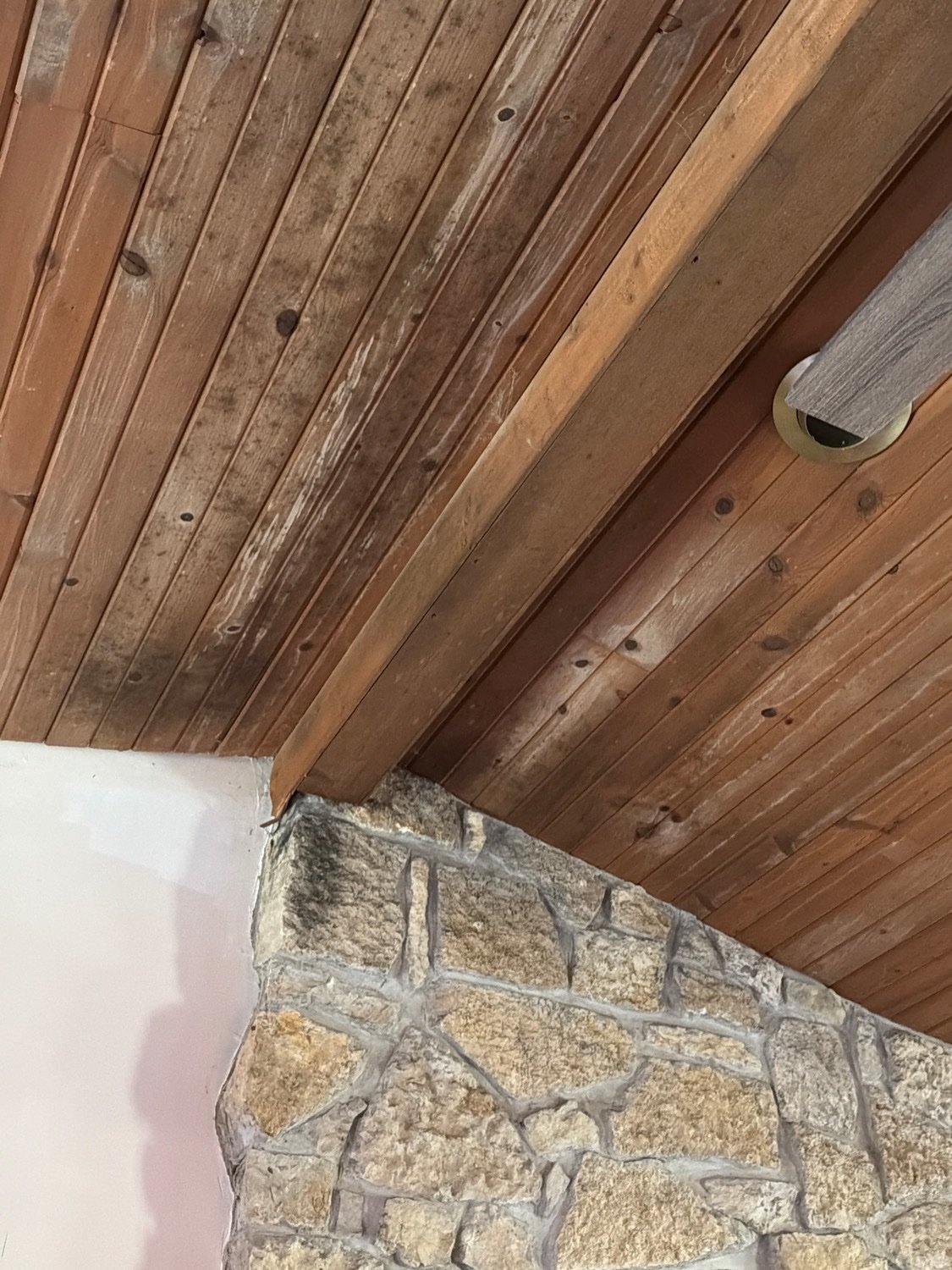
Staining like this shows water has been getting in over time. It does not, by itself, prove what is growing there. That is where mold testing comes in: sampling sent to a laboratory gives you a result you can act on, instead of a guess based on color alone. Our mold testing service pairs sampling with a moisture check, because the source matters as much as the sample.
Tracing the staining to the chimney flashing
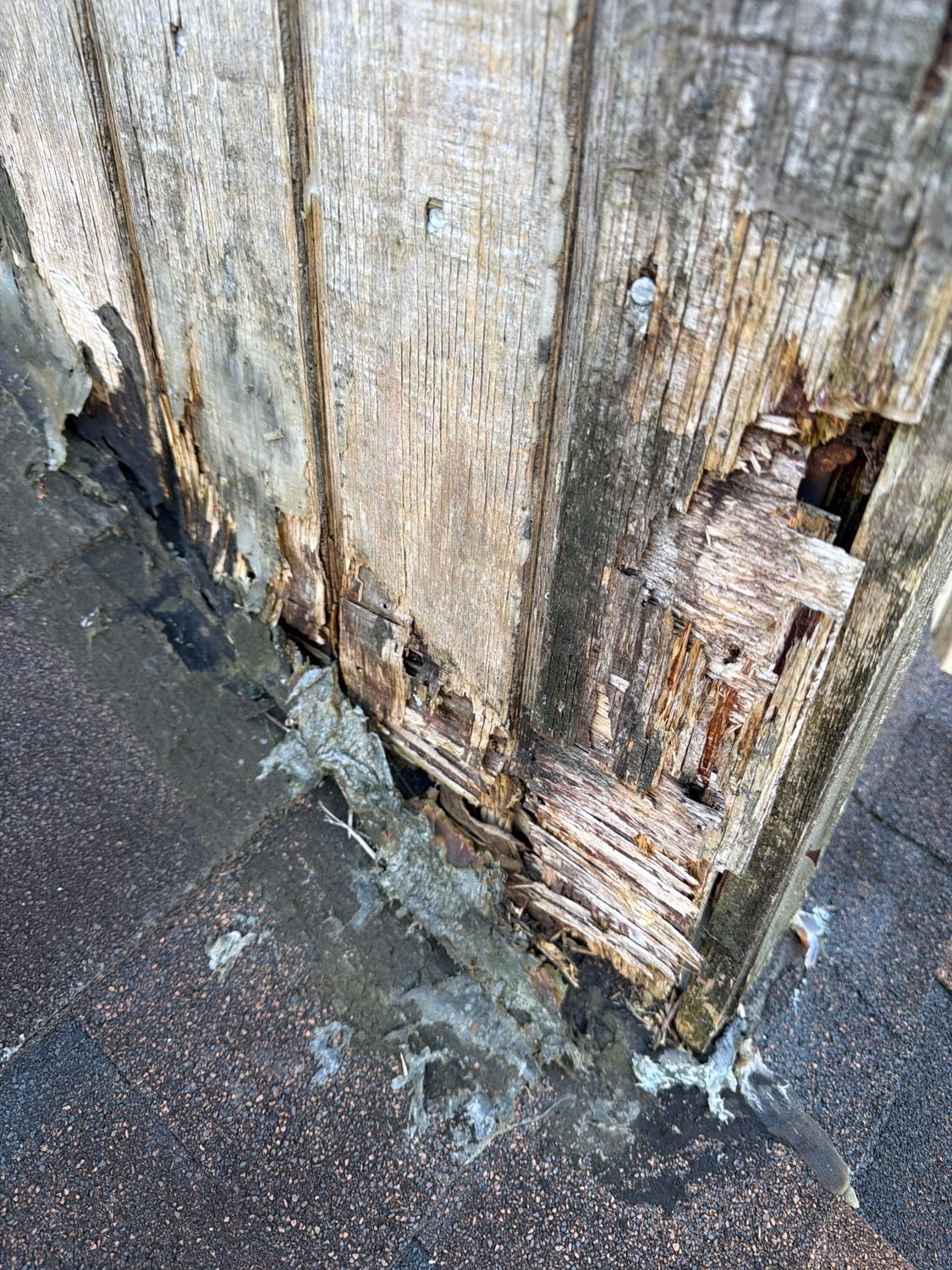
Outside, at the base of the chimney chase where it meets the shingles, the siding shows moisture damage and deterioration, and the sealant at the flashing line has failed. That chimney flashing leak is the source that traces to the attic gable and ceiling staining inside.
Flashing is the metal work that seals the joint where a chimney meets the roof. When that joint opens up — failed sealant, damaged flashing, or moisture-damaged material at the base — rain follows the chimney down into the attic and across the ceiling below. Sealant alone is a maintenance item, not a permanent fix for a failed flashing joint. The correction is for a qualified roofer or chimney contractor to repair the flashing and the damaged material at the base, so water sheds outside the roof system again.
A separate moisture source: the bathroom fan
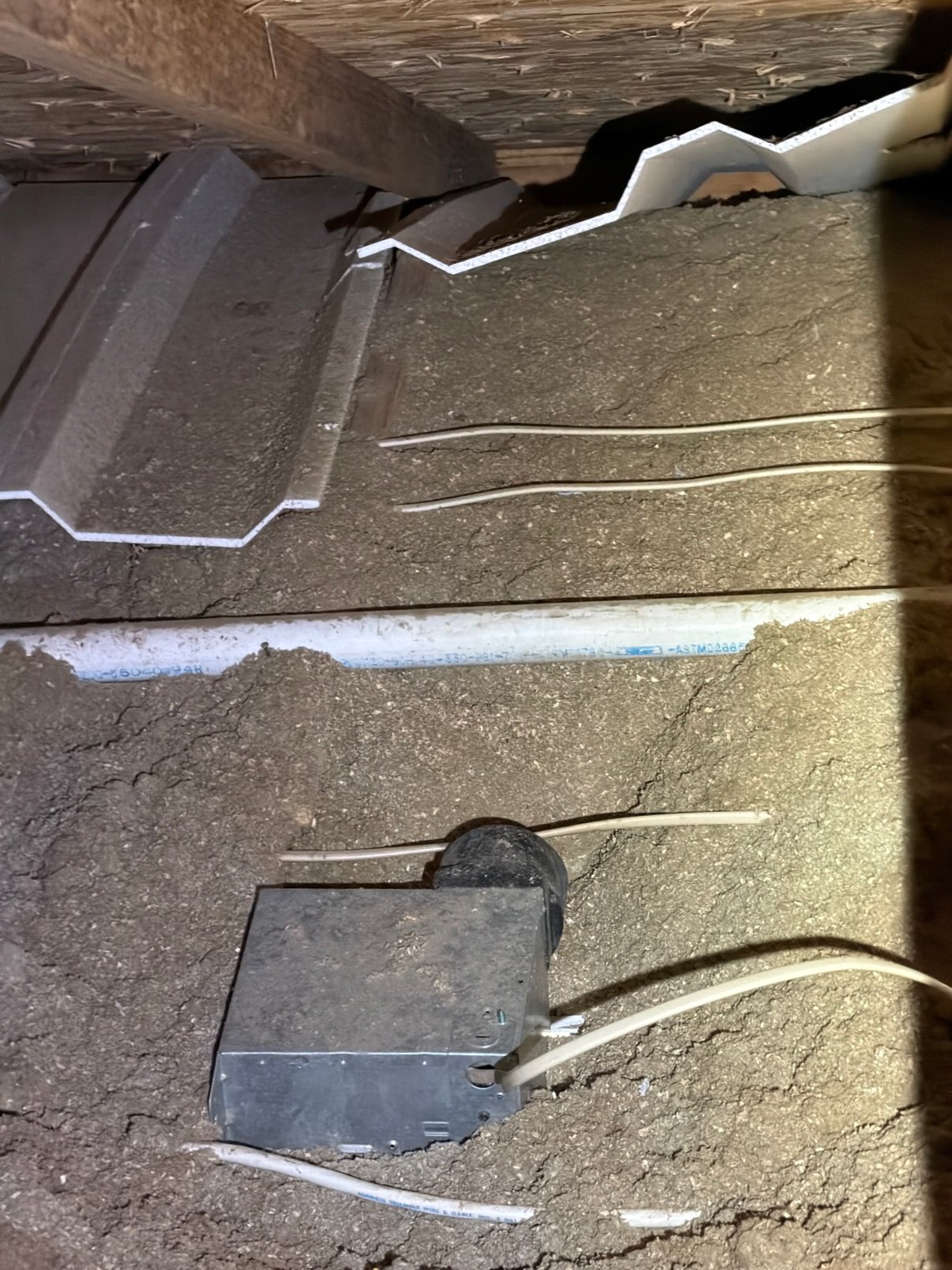
The same attic held a second, separate finding: a bathroom exhaust fan housing sitting in the insulation with no duct run to the exterior. That fan is not the cause of the chimney staining — it is a separate moisture source of its own.
Every shower puts warm, moist air through that fan. If the fan vents into the attic instead of outside, that moisture is delivered into the attic space, where it can condense on cold sheathing and framing in winter. Over time, that is exactly the damp, still-air condition where mold growth starts. The fix is straightforward: duct the fan to the exterior, through the roof or a wall, so the moisture leaves the house.
Keeping these two sources separate matters. Fixing only the fan would leave the roof leak active. Fixing only the flashing would leave daily bathroom moisture pumping into the attic. A good report lists each source for what it is.
One more moisture source in the crawlspace
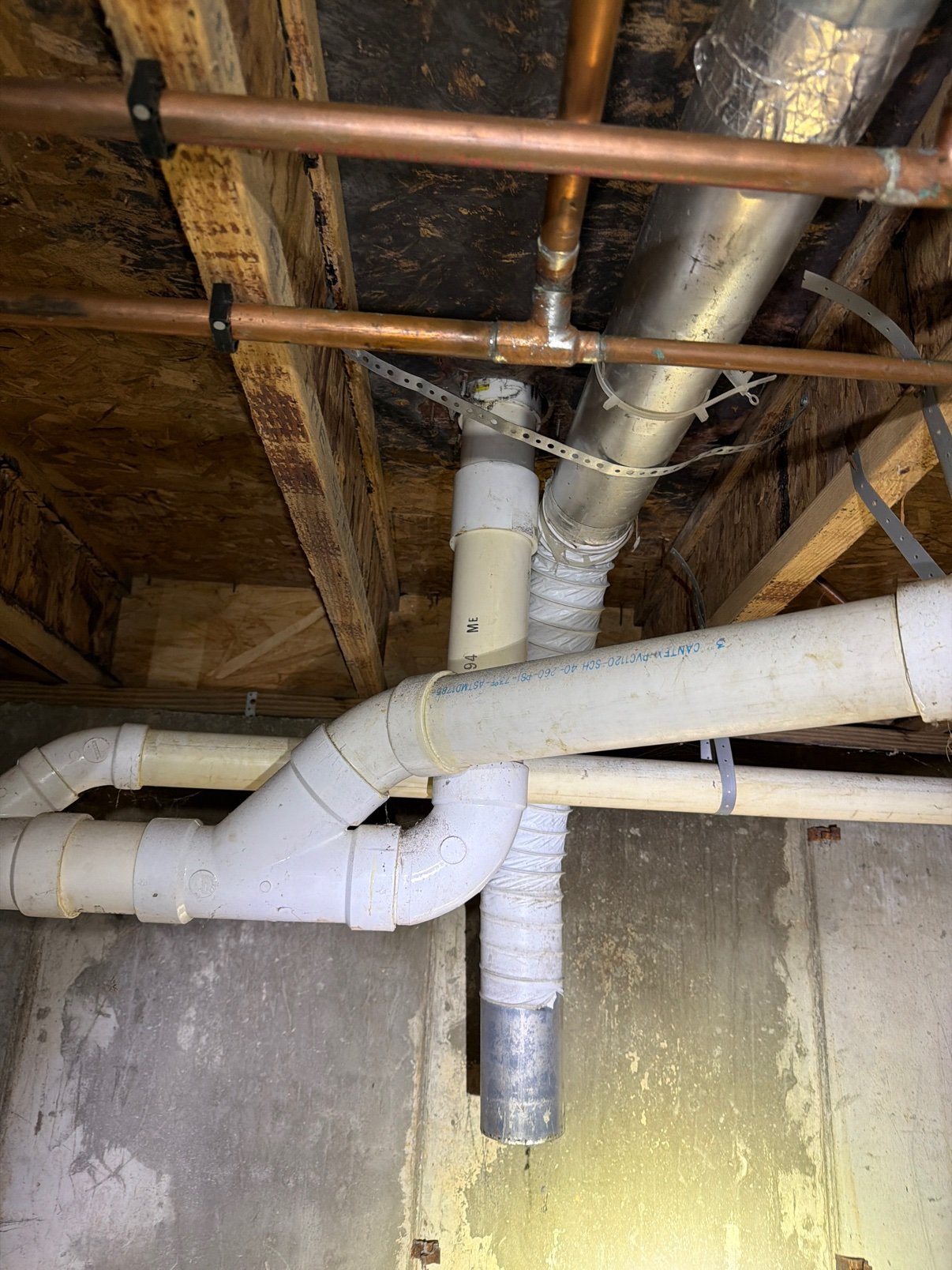
Down in the crawlspace, we found dark staining across the subfloor, and a dryer vent duct disconnected and hanging open — exhausting warm, moist dryer air into the crawlspace instead of outside. That disconnected vent is the moisture source for the crawlspace subfloor staining. Reconnecting and properly supporting the duct to its exterior termination is a small job that stops a steady moisture supply.
Three areas, three separate moisture sources. That pattern is common in older Connersville homes, and it is why a mold concern is never just about cleaning a spot you can see.
Why mold testing, and what it does
Mold needs moisture. Testing answers two questions: what is present, and where is the moisture coming from? Air mold testing — our standard is four canisters for $375 — collects samples that go to a laboratory for analysis. The lab result is documented in your report when the laboratory period completes, along with the moisture sources found during the inspection.
If you are buying in Connersville, testing makes sense when you see visible staining or growth, smell a musty odor, or know a home has had leaks or a damp crawlspace. If you are selling, fixing the moisture source before listing is almost always less costly than negotiating over an unknown after a buyer’s inspection.
The inspection itself covers what is visible and accessible at the time. We do not open walls, and we do not guess at what is behind them. What we can see in the attic, the crawlspace, and on the roof, we document with photos, in plain language.
How the day ends
Near the end of the inspection, buyers join us for a wrap-up: everything we found, gone over on site, with every question answered before we leave. The written inspection report follows the same day, and any lab results follow when the laboratory period completes. You can see all the towns we cover on our service area page, and what a full inspection covers on our home inspection page. With two inspectors on our team, we can typically get your inspection scheduled inside the 7-to-10-day inspection response window in your purchase contract.
Call or text (765) 965-7793 to schedule.
Certified Home Inspection LLC has been inspecting homes in Connersville and across East-Central Indiana and West-Central Ohio since 2004. Founder Mike Spurrier is licensed in Indiana and Ohio, and inspector Jake Slinker is licensed in Indiana.